
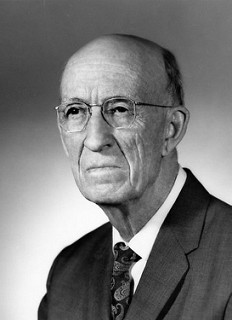
Professor Orin A. Stevens [3].
Stevens has written and published more than 200 hundred articles in 40 different scholarly journals on topics ranging from plants, weeds, birds, and North Dakota towns. One of his more interesting accomplishments came in 1917. Stevens was studying weeds in America that came from Europe and sent lamb’s quarters to the United States National Herbarium for analysis. Another scientist, Dr. Paul Allen of Switzerland, wanted the lamb samples as well. Those samples that Allen got had one species that had not yet been cataloged yet. Thus, Dr. Allen named the species Stevensii in his honor.
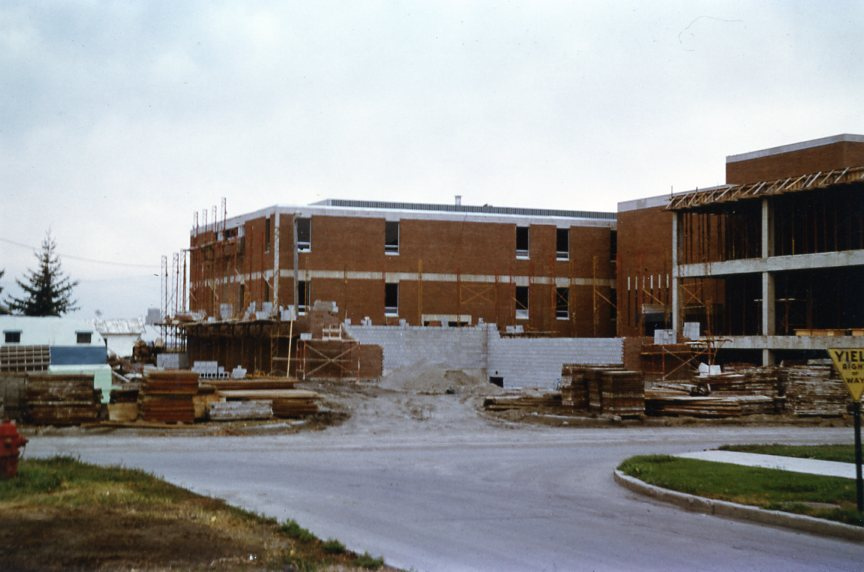
Construction of Stevens Hall, circa August 1967. [4]
In 1968, a 1.3 million dollar building that would house biology, zoology, geography, and wildlife management was named in Dr. Stevens honor. Retirement was not much of a retirement for Stevens because he still continued to conduct research and write on campus. What was remarkable about this man was that he rarely drove his car; he would ride or walk to school even into his 80s. Colleagues would see him come to work in the morning at 5:30 am and wouldn’t leave until the sun went down. Stevens worked at NDSU until he suffered a stroke in 1976. His wife, Julia, then moved to California to be closer to family. In 1979, Stevens died surrounded by family. NDSU will forever be grateful for his research in the botany field for his research and academic contributions. [2]
- NDSU Archives, “Finding Aid to the O.A. Stevens Papers.” Accessed November 2, 2016. http://library.ndsu.edu/tools/dspace/load/?file=/repository/bitstream/handle/10365/478/Stevens%2cO.A.Papers.pdf?sequence=5
- North Dakota State University. “Stevens Hall.” Accessed November 2, 2016. https://www.ndsu.edu/alphaindex/buildings/Building::409
- Photo by NDSU Archives. https://flic.kr/p/8AHs4x
- Photo by NDSU Archives. https://flic.kr/p/8AHs3T


