
Established in 1879, Riverside Cemetery is Fargo’s oldest, and largest, cemetery with over 18,000 citizens of the dead.
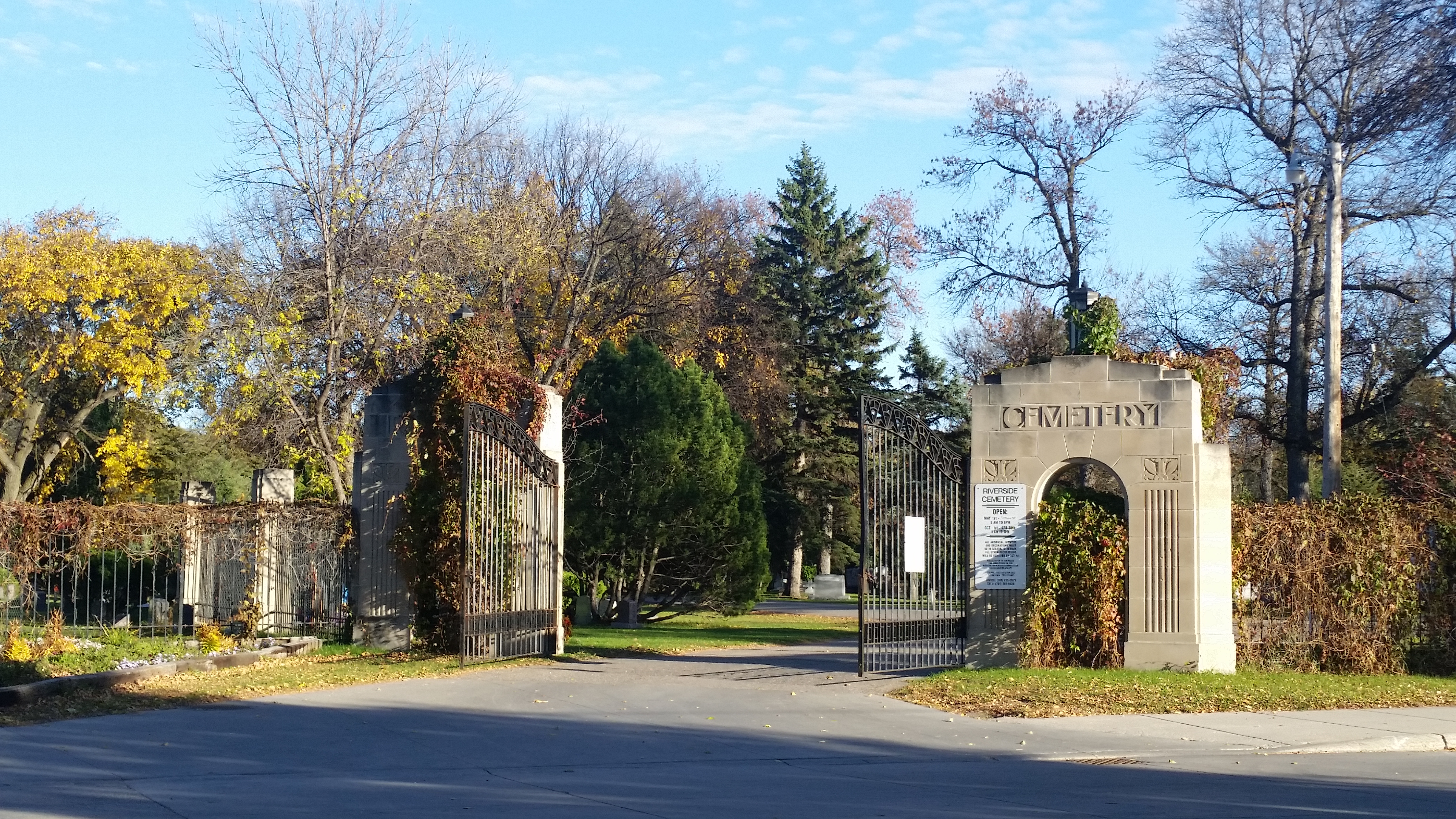
Riverside Cemetery Gates, fall 2016
In 1880 Fargo’s sprawl only reached as far south as Roberts Street (now Seventh Avenue), putting the cemetery a mile and a half outside of town. Why the long trek?
Before 1830 cemeteries as this one were non-existent. The dead were generally buried near the town chapel or in the town commons (places like Island Park) but those locations were filling. Coffins were sometimes stacked six deep causing tremendous issues during floods, when the earth would crumble away or sink. As well, cholera and yellow fever outbreaks in the larger cities in America had led to bodies waiting to be buried and the fear that disease would spread from the deceased to the living. Luckily, by the time folks were settling the Fargo Township, rural cemeteries were the well-established norm, and Island Park, since its establishment as such by European settlers, has never used as a burial ground.
In the early days of Riverside, most funerals were still taking place in the home, but the chapel on the grounds was used as well. A horse drawn carriage would have carried the decedent to the east side of the building to offloaded for services in the main chapel. That chapel, now restored, is the brick building at the center of the grounds. It is used for administrative offices and contains a cremation retort.
Riverside’s first burial was Mrs. Climena Lowell interred in 1878, over a year before the cemetery was surveyed for the purpose of a burial ground. Later, as the cemetery lands grew and land was bought and sold, Mrs. Lowell’s husband, Jacob, and son, Jacob Jr., would own block 13, the section she’s buried in, while the rest of the acres would go to Louis B. Hanna, who would later become a ND Governor!
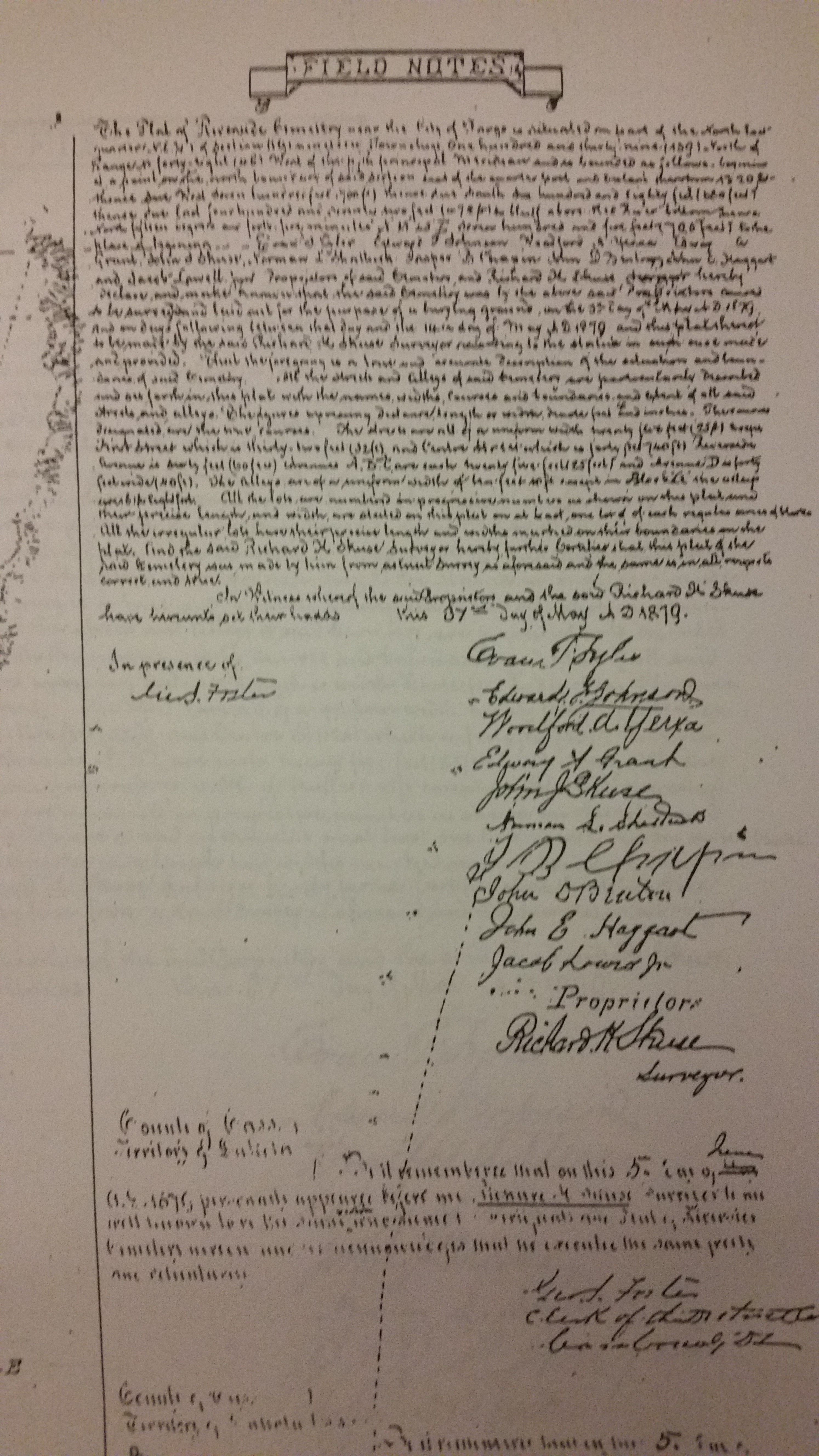
Field Notes from Riverside Cemetery’s early days are sometimes difficult to decipher, like these from May 31, A.D. 1879
In 1903, to secure the title of Riverside Cemetery, the graveyard association was formed with a president, secretary, treasurer, and board of directors. Hanna, treasurer, sold his portions to the association and they continued buying land to add to the booming business of death. 260 red cedars were planted in 1903, 6 acres was purchased to become the superintendent’s residence, and crops had to be dug up and removed at a cost to afford the cemetery’s expansion.
Park Addition was made in 1906, the mortuary and reception vault were built in 1909, the mausoleum was constructed in 1920, and a horse-drawn lawnmower was purchased in 1920, as well.
A recent interview with Riverside Cemetery employees revealed that early records, like the “field notes” seen here are hard to read and that over time, as Riverside expanded and became bordered by I-94, a few of Fargo’s decedents may still be buried in Lindenwood Park.
Famous interments include:
Smith Stimmel, security guard to President Abraham Lincoln, buried in Riverside in 1937. Can you find his tombstone? Do you notice anything of significance about his date of death? Stimmel died at age 92 on April 14, 1935—exactly 70 years after the assassination of the President he served. For more on Stimmel, visit the home he spent his final years in. (111 8th St S) Plot: Southpark Block 31
William Frederick Lemke, US Congressman and Union Party Candidate for President in 1936 (FDR won), was elected to represent North Dakota in the United States House of Representatives, serving from 1933 to 1941, and 1943 until his death in 1950. Lemke was a man who wanted to protect farmers but often came across and stubborn and unrefined to those in Washington. One reporter described him as “a skinny little guy with a puckering squint of a smile, and a casting director would type him for a hick…He went to Yale…and went around more college than an old-time tramp athlete and he is positively no yokel.” (3) Plot: Southpark Section U
Sources:
- “Riverside Cemetery: Fargo.” Accessed October 14, 2016. http://www.riversidefargo.com/history.php.
- Greenfield, Rebecca. “Our First Public Parks: The Forgotten History of Cemeteries.” The Atlantic, March 16, 2011. http://www.theatlantic.com/national/archive/2011/03/our-first-public-parks-the-forgotten-history-of-cemeteries/71818/.
- Blackorby, Edward C. “William Lemke: Agrarian Radical and Union Party Presidential Candidate.” The Mississippi Valley Historical Review 49, no. 1 (1962): 67–84. doi:10.2307/1889466.
- Workman, Maxine. “History of Riverside Cemetery.” The River Genealogical Society, August 3, 1994. Accessed at Riverside office by Shannon Ueker, November 9, 2016 with permission from Katie Haugen.


